
Beyond the Gown: Decoding the Neuro-Inclusive Chambers
- Nat Hawley

- Jun 10
- 6 min read
On Tuesday 3 February 2026, the legal community gathered at Deka Chambers for an event hosted by ABC Partnership called “Neuro-Inclusive Chambers: Building Understanding & Confidence.” I (Nat) led the session as the founder of Divergent Thinking, and what struck me most was this: the room was full of people who know the Bar demands exceptional thinking, but who are only just beginning to ask whether Chambers are truly designed for the full range of minds already working within them.
This did not feel like a standard CPD evening. It felt like a profession starting to confront something deeper.
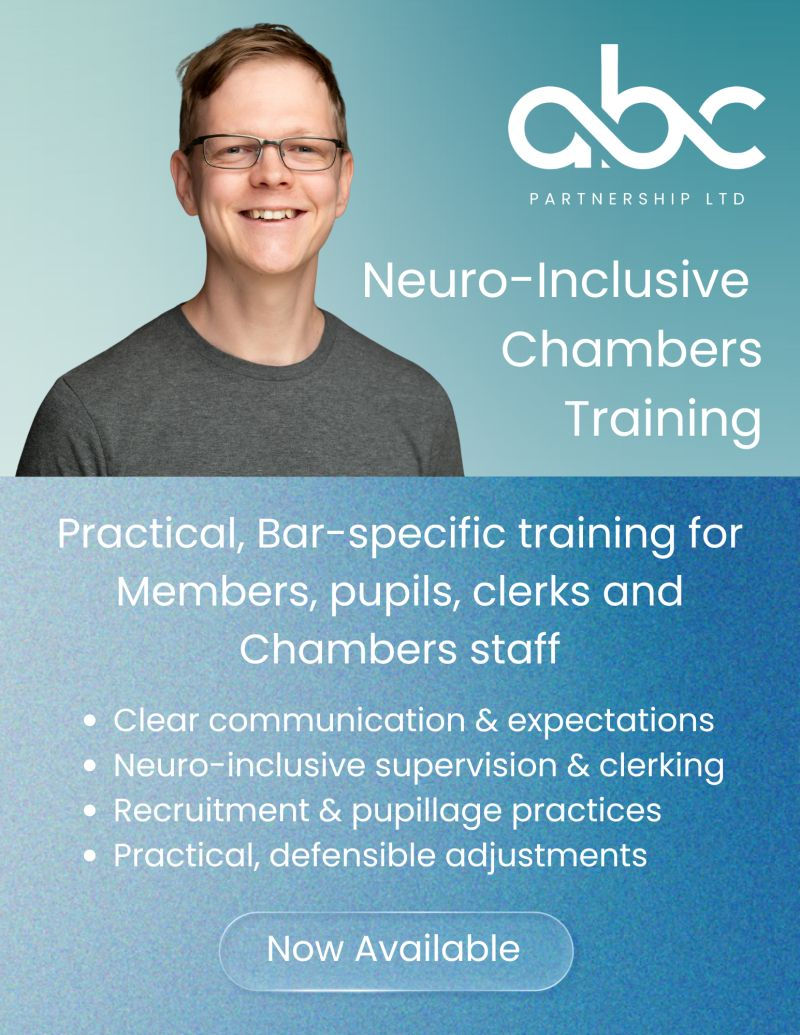
The event brought together senior leaders, clerks, HR and people teams, pupillage supervisors, barristers and neurodivergent professionals to explore what neuro-inclusion actually looks like in Chambers life. ABC Partnership’s framing was practical from the outset: not abstract awareness, but how Chambers can better understand, support and empower neurodivergent barristers, clerks and pupils.
Why this conversation matters at the Bar
The Bar is often imagined as a profession built almost entirely on intellect, judgement and communication. That is true, but it hides something important.
The profession also runs on unwritten rules, intense time pressure, hierarchy, long-hours culture, auditory overload, ambiguous communication and a very narrow idea of what competence is supposed to look like. For neurodivergent people, that combination can create enormous friction.
And that is the irony.
Many of the very traits Chambers depend on — pattern recognition, deep focus, analytical precision, creative argument-building, unusual memory structures and systems thinking — are often found in neurodivergent profiles. Yet the environment those minds are asked to work in can still feel badly matched to how they naturally process the world. That is not a small contradiction. It is a structural one.
This is a theme I return to often through Divergent Thinking: too many workplaces say they value difference while still building systems around one narrow idea of what “professional” thinking should look like.
The legal profession still confuses brilliance with fit
One of the things I wanted to challenge in the session was the assumption that if someone is truly talented, they should be able to cope with the environment as it currently exists.
That is one of the oldest myths in professional culture.
It sounds like rigour, but often it is just inertia. It assumes the environment is neutral and the person is the variable. It frames support as a favour rather than asking whether the system itself is creating unnecessary drag.
In Chambers, that drag can show up in obvious and subtle ways:
clerks’ rooms or communication patterns that rely heavily on fast verbal processing
last-minute changes delivered with little structure
expectations that everyone can manage the same social and sensory load
rigid assumptions about professionalism and presentation
long-hours cultures that reward endurance rather than effectiveness
A neurodivergent barrister may still do excellent legal work and pay a far higher internal cost to do it. That cost is often invisible until someone burns out, withdraws, or starts to look as though they are “struggling” in a way that gets personalised rather than properly understood.
The “spiky profile” belongs in Chambers too
A core part of the evening was bringing the idea of the spiky profile into a legal setting.
A spiky profile means someone can have very high ability in some areas alongside real difficulty in others. That does not make them less capable. It makes them uneven in ways that standard systems often find hard to interpret.
At the Bar, a person might be:
brilliant in legal reasoning but drained by chaotic admin
exceptional in court but slowed by poorly structured written instructions
highly persuasive but overloaded by the wrong sensory environment
outstanding at strategy but held back by a culture built around one narrow style of working
Traditional professional cultures often reward the illusion of being evenly competent at everything. But that is not where much of the most interesting talent sits. Some of the strongest legal minds are not “well-rounded” in the blandest sense. They are pointed, specific, intense and unusually strong in the places that matter most.
The question is whether Chambers know how to recognise that — and build around it.
The event itself showed the profession is moving
What made the evening especially encouraging was that it was not just a keynote and a quick Q&A. It brought together different parts of the profession to engage seriously with the subject.
Alongside my session, the evening included a fireside chat drawing on lived experience from across Chambers life and a preview of ABC Partnership’s new Neuro-Inclusive Chambers training module. That matters because the legal profession does not need more surface-level diversity language. It needs practical tools, better understanding and a willingness to rethink inherited norms.
That is also why I care so much about turning these conversations into practical change through training, strategy and neuroinclusion support, rather than letting them remain one-off moments of awareness.
Neuro-inclusion is not charity. It is performance design
I think this is the point the profession most needs to hear.
Neuro-inclusion is not about lowering standards. It is not about creating a softer version of Chambers life. And it is not about adding a few symbolic gestures for equality statistics.
It is about performance design.
If a barrister works better with visual case-mapping, that is not indulgence.
If structured communication between clerks and counsel reduces avoidable friction, that is not special treatment.
If a pupil needs more explicit expectations or a less chaotic route into work, that is not weakness.
If a Chambers reviews its sensory environment, supervision practices or workflow design, that is not box-ticking. It is operational intelligence.
The most effective adjustments are often low-cost and ordinary. But their impact can be profound because they reduce friction where friction never needed to be there.
And once you start seeing neuro-inclusion that way, it becomes obvious that it benefits more than one individual. It improves communication, clarity, workflow and sustainability across the whole set.
The future of the Bar is not “well-rounded”
One of my strongest reflections from the evening is that the old generalist ideal is becoming less convincing.
The profession has long been shaped by the idea that the strongest barrister is the one who can do everything, tolerate everything and function smoothly in every context. But I think the future belongs less to the person who looks effortlessly “well-rounded” and more to the person who understands their own cognitive profile and works in an environment that allows their strengths to show up fully.
That is why I think the future of the Bar is specialist, not generic.
Not in the sense of narrow legal practice areas alone, but in the sense that Chambers need to understand the distinct cognitive signatures of the people within them. They need to stop assuming every strong barrister will think, communicate, organise and process in the same way.
Because they do not.
And they never did.
Why 2026 feels like a tipping point
There is a reason this conversation feels more urgent now.
Clients are more demanding. Work is more complex. The pace of information is higher. The profession is under pressure to retain talent, modernise culture and rethink what leadership looks like. In that context, cognitive diversity is not a side issue. It is part of competitive advantage.
Clients do not only want lawyers who know the law. They want lawyers who can:
see what others miss
challenge assumptions
process complexity differently
spot patterns in large volumes of information
bring precision and originality under pressure
Those are not abstract ideals. They are commercial and professional realities.
So if Chambers are still forcing divergent minds to run on old professional hardware, they are not just creating avoidable exclusion. They are weakening their own future.
From awareness to action
One of the reasons I was pleased to be part of this event is that it created a bridge between awareness and implementation.
That bridge is often where good intentions either become practical change or quietly disappear.
For Chambers wanting to move beyond general discussion, the next step is not another broad statement about inclusion. It is looking honestly at:
recruitment
pupillage processes
clerking communication
supervision styles
sensory environment
workload norms
performance expectations
routes to adjustment and support
That is where the real work begins.
It is also where workplace assessments and practical neuroinclusion support can make the biggest difference, because they shift the conversation from theory to specific design choices.
Final thought
What happened at Deka Chambers on 3 February felt important because it suggested the profession is beginning to move from awareness to architecture.
Not:
“Do we care about neurodiversity?”
But:
“How do we build Chambers that actually work for different kinds of legal minds?”
That is the right question.
Because neuro-inclusion at the Bar is not about being nice. It is about being accurate enough to recognise talent, intelligent enough to reduce unnecessary friction, and ambitious enough to build a profession that reflects the full brilliance already inside it.
That is the shift.
And it is long overdue.
To learn more about the event, visit the ABC Partnership event page. To explore more of my work through Divergent Thinking, visit the blog or learn more about workplace needs assessments.



Comments