
Collaboration spotlight: BIT + Divergent Thinking on accessible hiring and training

Updated: Aug 29
For Neurodiversity Celebration Week Divergent Thinking and the Blind Institute of Technology share practical, low-cost fixes that make hiring and training clearer, more accessible, and more effective.
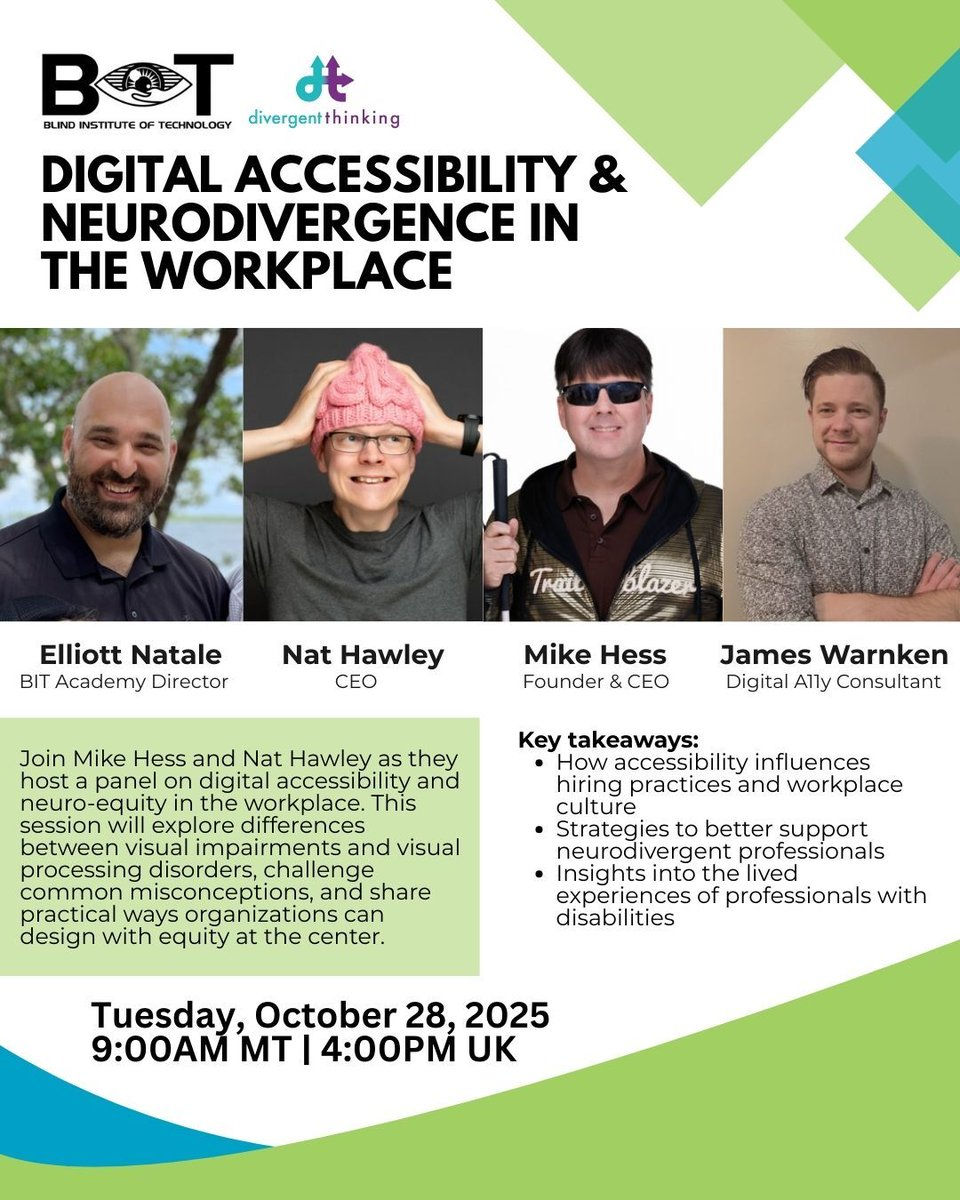
For Neurodiversity Celebration Week, we teamed up with the Blind Institute of Technology (BIT) to publish a guest piece on a topic that sits right at the overlap of accessibility and neuroinclusion:
If your systems aren’t designed for different ways of thinking and accessing information, you’re not “missing out on a few candidates”. You’re systematically leaking talent.
Read the BIT post here: Designing Equitable Hiring and Training: Simple Changes That Support Blind and Neurodivergent Talent.
Why we’re sharing this during Neurodiversity Celebration Week
Neurodiversity Celebration Week is a useful forcing function. It’s the moment to move from “awareness” to design decisions: how you brief, recruit, onboard, train, and communicate day-to-day.
BIT’s work focuses on accessible pathways for blind professionals and professionals with disabilities. At Divergent Thinking, we focus on practical neuroinclusion: clearer systems, lower cognitive load, and ways of working that stop people burning energy translating chaos.
This collaboration is where those two conversations meet.
The core idea: inclusion starts before the first interview
A lot of organisations treat accessibility and inclusion like a “later” problem: after hiring, after disclosure, after someone starts struggling.
But if your job ads are vague, your portals are clunky, your assessments reward speed over skill, or your interview process tests social performance rather than job capability, you’re filtering people out before ability even gets a fair shot.
That’s not a “reasonable adjustments” problem. It’s a design problem.
Accessibility and cognitive clarity belong in the same conversation
One of the most useful things about this piece is how it links two often-separated worlds:
Technical access (screen readers, document formatting, alt text, compatibility)
and
Cognitive access (clarity, structure, predictable steps, not drowning people in ambiguity).
A system can be technically accessible and still cognitively exhausting. And if it’s cognitively exhausting, you’ll lose people.
Training either unlocks talent, or quietly shuts it down
Hiring is only half the story. Onboarding and training often fail in the same predictable ways:
Information is delivered in dense blocks
Priorities aren’t explicit
People are told to “pick it up as you go”
Materials aren’t accessible (or aren’t usable)
The fix is not “more content”. It’s better structure.
Inclusive training tends to be predictable, chunked, multi-format, and explicit about what good looks like and what happens next.
A quick checklist: small fixes that make a big difference
If you want a fast starting point, these are the kinds of adjustments that tend to improve outcomes quickly:
Write job descriptions in plain, direct language
Remove jargon, hidden expectations, and “soft” requirements that aren’t actually required.
Make every stage of the process explicit
What happens next, when, how long it takes, and what “good” looks like.
Check your tech actually works with assistive technology
Don’t wait for someone to request a workaround after they’ve hit a barrier.
Review whether assessments measure the job
Time pressure and ambiguity are not the same as competence.
Design training for real humans
Chunk content, use clear headings, add alt text, keep structure consistent, and build in processing time.
Why this is an ops advantage, not a “nice-to-have”
When information is buried, inconsistent, or hard to decode, people spend time fighting the format instead of doing the work.
Clearer systems reduce rework, improve communication, speed up onboarding, and make performance assessment fairer. That’s not just inclusion. That’s operational excellence.
If you want the full argument
Read the BIT guest post here: Designing Equitable Hiring and Training: Simple Changes That Support Blind and Neurodivergent Talent.
And if you want more on practical neuroinclusion (workflows, meetings, comms, adjustments that stick), explore: Divergent Thinking. (https://www.divergentthinking.uk/)


Comments