
Doughty Street Chambers: Practical neuroinclusion for client-facing teams at Doughty Street Chambers

Updated: Aug 28
A tailored session helped staff at Doughty Street Chambers respond more clearly and confidently when clients, visitors or colleagues may be overwhelmed, distressed or communicating differently.

At a glance
Organisation: Doughty Street Chambers
Audience: Client and visitor-facing staff
Format: Hybrid lunch-and-learn
Participation: Approximately two dozen people
Focus: Clear communication, professional boundaries and needs-led support
Moving beyond general awareness
Doughty Street Chambers wanted a neurodiversity session that staff could apply in real conversations.
People working with clients and visitors sometimes need to respond when someone appears overwhelmed, confused or distressed. A person may communicate differently or need more time and clarity, without having disclosed a diagnosis or knowing exactly what support to request.
The challenge was to help staff respond with empathy while maintaining clear professional boundaries. The session needed to be practical, relevant and useful in the moment—not simply an introduction to terminology.
What Divergent Thinking delivered
Divergent Thinking designed a hybrid lunch-and-learn for approximately two dozen participants joining in person and online.
The session explored:
neurodiversity beyond common stereotypes;
supporting people according to their needs without requiring disclosure;
communicating clearly when stress or cognitive load is high;
reducing ambiguity and making the next step easier to understand;
checking understanding without sounding patronising;
maintaining calm, appropriate professional boundaries; and
avoiding assumptions or attempts to diagnose someone.
Realistic examples helped participants consider how small changes in language, pace and process could make difficult interactions easier to navigate.
The session also modelled the approach it encouraged. Information was introduced in a clear sequence, participants could contribute without sharing personal information, and questions were welcomed throughout.
What participants took away
Immediate feedback indicated that participants felt more confident discussing and responding to neurodiversity.
People described intentions to:
pause before reacting;
avoid making assumptions about someone’s behaviour;
slow down and make communication clearer;
ask questions to understand what the person needs; and
explain actions and next steps more explicitly.
The organiser described the session as “excellent” and “spot on”. Seven recorded feedback responses were positive about the relevance and accessibility of the session.
These responses show that participants found the learning useful and identified practical changes they wanted to make.
Participant voice
“Nat was an incredibly engaging speaker and his use of personal anecdotes alongside his infectious enthusiasm made this incredibly helpful in helping me understand more about neurodiversity.”
Why this matters
Neuroinclusive client service is not about identifying who may or may not be neurodivergent.
It is about communicating in ways that remain clear, respectful and effective when somebody is under pressure or needs information presented differently.
Small changes—slowing an interaction down, reducing ambiguity, checking understanding and making the next step visible—can help teams support more people without compromising professional standards.
More work in the legal sector
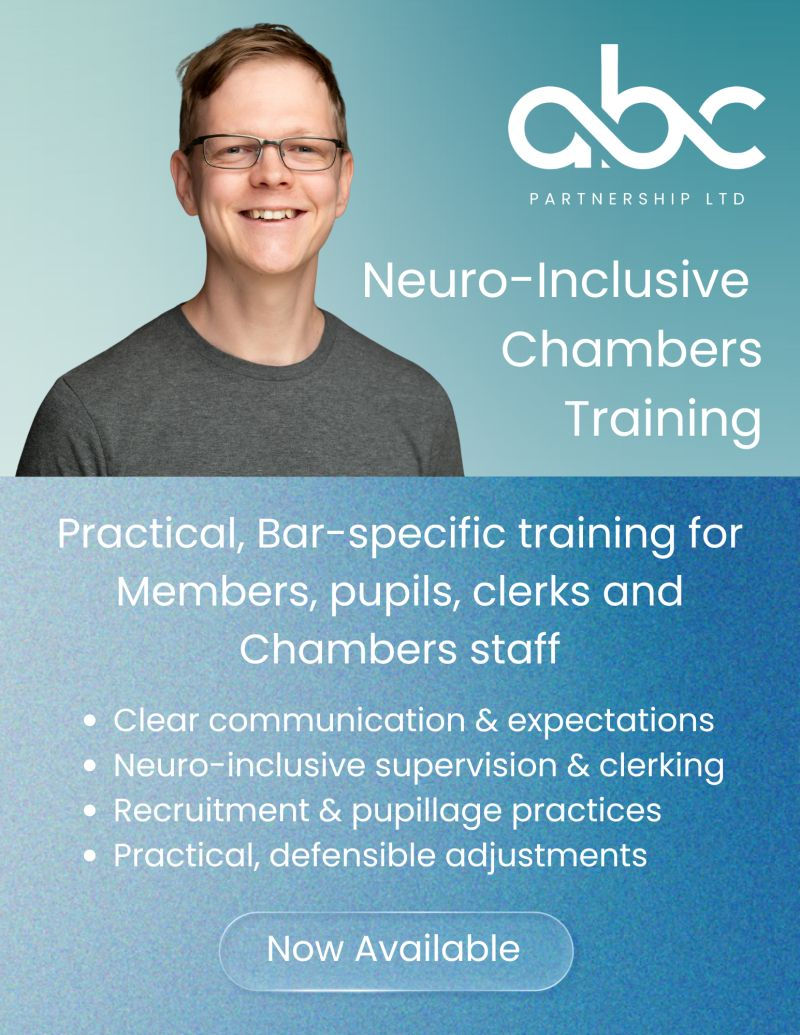
Our legal-sector work also includes authoring the Neuro-inclusive Chambers e-learning module for ABC Chambers Solutions and contributing to the “Championing and managing neurodiversity” panel at the Bates Wells Employment Conference.
Bring practical neuroinclusion to your team
If you’re considering something similar for your organisation, explore our neuroinclusion lunch-and-learns or get in touch to talk through the situations your team handles.


Comments